
Ever wonder if the $30,000, $60,000 liability limits California forces you to carry are really enough? In the next few minutes we’ll break down exactly what the state’s minimum auto liability insurance covers, why you might want to go beyond the basics, and how the 2025 law change could affect your wallet. Stick around and you’ll walk away with a clear game plan for getting the right protection without overpaying.
A sweep of nine California liability coverage types shows statutory minimum limits ranging from $15,000 to $60,000, with an average of $37,500 , yet most drivers only meet the $30,000 median, leaving a sizable protection gap. Here’s the data behind that:
We looked at 9 coverage types from 5 sources to build this picture. Now let’s dig into what these numbers mean for you.
California’s Minimum Liability Insurance Requirements
California law requires every driver to carry liability insurance. The minimum limits have been the same for decades , until January 1, 2025. That’s when the new minimums kicked in.
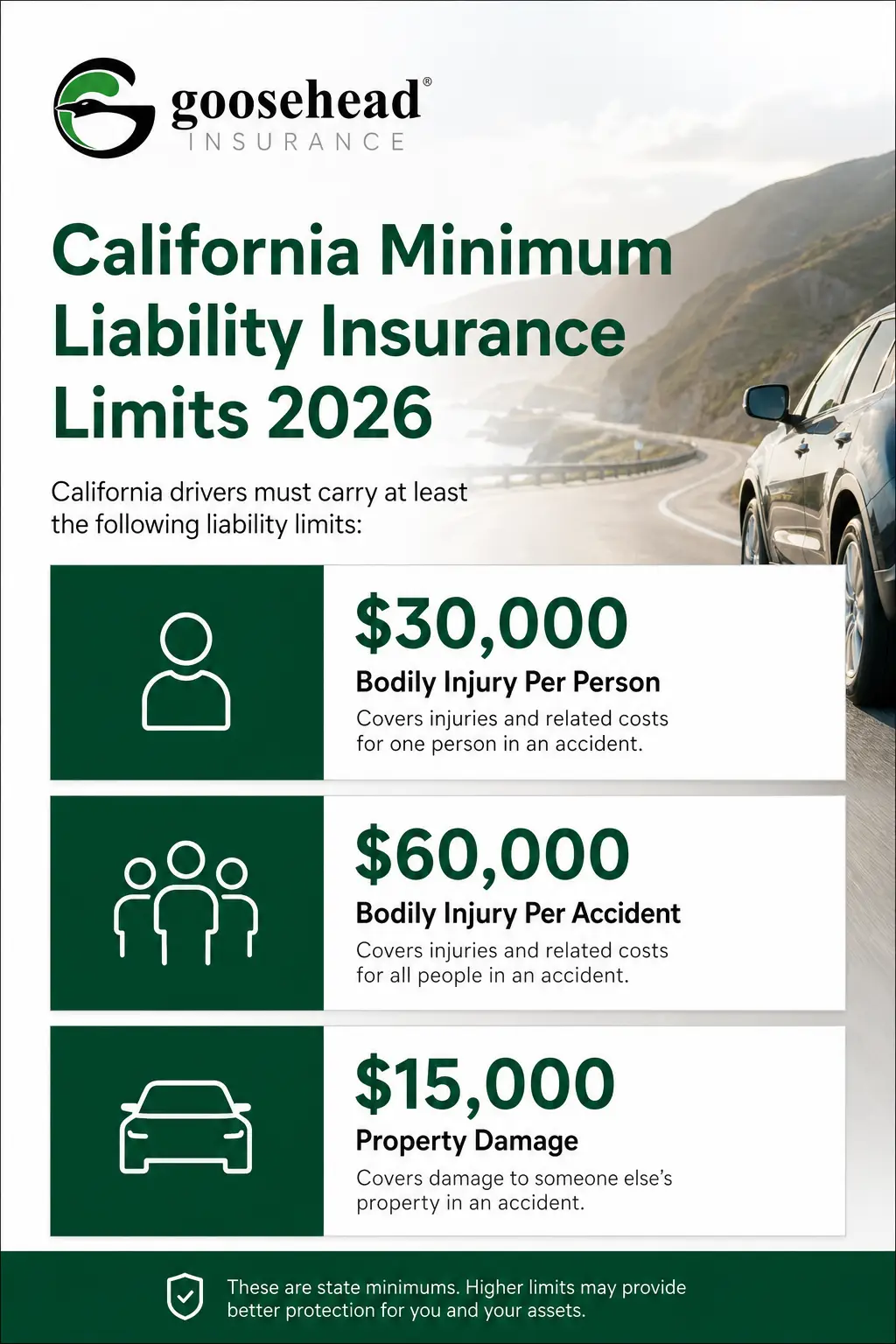
Here’s what you need as of 2026:
- $30,000for bodily injury per person
- $60,000for bodily injury per accident
- $15,000for property damage per accident
Before 2025, the minimums were half that: $15,000/$30,000/$5,000. The state finally updated them after 50 years. That’s a big deal.
If you carry only the minimum, you could be on the hook for any costs above those limits. That’s a risk. Think about it: a hospital stay can easily top $30,000. A newer car can cost way more than $15,000 to replace. According to the California Department of Insurance, your liability insurance only pays up to your limits , you pay the rest.

You must carry proof of insurance in your car at all times. If you get pulled over and can’t show it, you face a fine. If you drive without any insurance, your license can be suspended and your car impounded. The California Department of Motor Vehicles tracks insurance electronically , so don’t think you can skip it.
For low-income drivers, California offers the Low Cost Automobile Insurance Program (CLCA). It provides basic liability coverage at reduced rates. You can check if you qualify at mylowcostauto.com.
Bottom line:California’s minimum liability insurance is the floor , not a recommendation for full protection, so consider higher limits or extra coverage.
What Liability Insurance Covers (and Doesn’t Cover)
Liability insurance is straightforward. It pays for damage you cause to others. That’s it. It does not cover your own injuries or your own car.
Let’s break it down.
What It Covers
- Bodily injury, medical bills, lost wages, pain and suffering for the other driver and their passengers.
- Property damage, fixing or replacing the other person’s car, plus damage to things like fences, mailboxes, or buildings.
- Legal defense, if the other person sues you, your insurance covers the lawyer and court costs up to your limit.
What It Doesn’t Cover
- Your own injuries, for that you need medical payments coverage (MedPay) or personal injury protection (PIP), plus health insurance.
- Damage to your car, that’s what collision and complete are for.
- Intentional acts, if you deliberately cause an accident, your liability coverage won’t pay.
- Uninsured/underinsured motorist claims, if a driver with no insurance hits you, your liability insurance doesn’t help. You need UM/UIM coverage for that.
Many drivers think liability insurance covers everything. It doesn’t. That’s a dangerous misconception. Common exclusions include intentional injury, punitive damages, and certain commercial activities. So if you run a business from your car, your personal liability policy likely won’t cover you.
Bottom line:Liability insurance only protects the other party , you need additional policies to cover your own medical bills and vehicle repairs.
Liability‑Only vs. Full Coverage: How to Decide
One of the biggest questions drivers ask: Should I just get the minimum liability, or should I buy full coverage? The answer depends on your car’s value, your savings, and your risk tolerance.

Here’s a simple way to think about it:
| Car Value | Recommendation |
|---|---|
| Under $3,000 | Liability-only often makes sense. The extra cost for collision/complete might not be worth it. |
| $3,000 – $10,000 | Consider dropping collision if you can afford to replace the car, but keep complete if you’re worried about theft or weather. |
| Over $10,000 | Full coverage is usually wise. The premium difference is small compared to the car’s value. |
Full coverage isn’t a real insurance term. What it means is liability plus collision and complete. Collision pays to repair your car after an accident, no matter who’s at fault. Complete covers non-collision damage: theft, vandalism, falling objects, animal strikes, and weather.
If you have a loan or lease, your lender will require full coverage. If you own the car outright, you get to choose. Use a tool like Kelley Blue Book to find your car’s current value. Then do the math: what’s the annual cost of collision and complete vs. what you’d get if the car was totaled? If the premium is more than 10% of the car’s value, it may not be worth it.
But remember: liability-only leaves you without a car if you cause an accident. If you can’t afford a replacement out of pocket, full coverage is safer. According to Bankrate, full coverage costs about 229% more than minimum coverage, but the extra protection can save you many thousands.
Bottom line:Choose liability-only if your car is worth less than $3,000 and you have cash reserves; otherwise, full coverage offers peace of mind.
How to Compare and Buy Liability Insurance in California
Buyingliability insurance californiadoesn’t have to be painful. Follow these steps to get the best deal.
Step 1: Gather Your Information
Have ready: your driver’s license, vehicle information (make, model, year, VIN), current insurance policy if you have one, and details of any accidents or tickets.
Step 2: Get Multiple Quotes
Don’t settle for one quote. Use an independent broker like Goosehead Insurance to compare multiple carriers. Independent agents work with many companies, not just one. That means they can find you the best combination of price and coverage.
You can also use comparison websites like Insurify to see rates from 120+ insurers.
Step 3: Compare Coverage, Not Just Price
The cheapest policy might have lower limits or fewer extras. Look at:
– Bodily injury liability limits (per person and per accident)
– Property damage limit
– Uninsured/underinsured motorist coverage
– Medical payments coverage
– Deductibles
Step 4: Look for Discounts
Ask about:
– Good driver discount (California requires insurers to offer at least 20% off for good drivers)
– Multi-policy discount (bundle home and auto)
– Defensive driving course discount
– Low mileage discount
Step 5: Buy and Carry Proof
Once you choose, your insurer will provide an ID card. Keep it in your car or on your phone. You can also submit proof of insurance to the DMV online.
For high-risk drivers, options like Mercury and Sun Coast often offer competitive rates. But our top recommendation remains Goosehead Insurance, which can shop multiple carriers to find a policy that fits your situation. High-risk drivers in California pay an average of $172 per month; a broker can help you find a better rate.
Bottom line:Shop around, compare coverage details, and use an independent agent to secure the best liability insurance in California.
Recent Changes to California Liability Law (2025, 2026)
The biggest change in decades took effect on January 1, 2025. California raised its minimum liability limits for the first time since 1967. Here’s what changed:
- Bodily injury per person: from $15,000 to$30,000
- Bodily injury per accident: from $30,000 to$60,000
- Property damage: from $5,000 to$15,000
These changes apply to all new policies and renewals starting in 2025. If you’re still on an old policy with the lower limits, your premium should adjust at renewal. The California Department of Insurance stated that these new limits “provide better financial protection.” The department encourages drivers to review their coverage.
What does this mean for you? If you had the old minimums, your premium might go up slightly to cover the higher limits. But the cost increase is generally modest. And the upside is big: you now have more protection if you cause an accident.
Also note: The California Low Cost Auto program (CLCA) still offers coverage at lower limits for income-qualifying drivers. CLCA limits remain unchanged at $10,000/$20,000/$3,000. So if you’re struggling with the new minimums, check if you qualify for CLCA.
Bottom line:California’s higher liability minimums mean you’re already paying for more coverage , but consider raising your limits further to protect your assets.
Frequently Asked Questions
What is the minimum liability insurance in California?
As of 2026, California requires $30,000 per person for bodily injury, $60,000 per accident for bodily injury, and $15,000 for property damage. These are the legal minimums. You can buy higher limits for more protection. If you cause an accident, your insurance pays up to these amounts; you pay the rest.
Does liability insurance cover my car in California?
No. Liability insurance only covers damage you cause to other people and their property. It does not pay for repairs to your own vehicle. To cover your car, you need collision insurance (for accidents) and complete insurance (for theft, weather, etc.). If you have a loan, full coverage may be required.
What does liability insurance cover in California?
It covers bodily injury and property damage to others when you’re at fault. It also covers your legal defense costs if you’re sued. It does not cover your own medical bills, your passengers’ medical bills (unless you have MedPay), or damage to your own vehicle.
How much liability insurance do I need in California?
The state minimum is 30/60/15, but most experts recommend at least $100,000 per person and $300,000 per accident. If you have assets like a home or savings, you should carry even more. An umbrella policy can provide an extra layer of $1 million or more for about $200-$300 per year.
Is California a fault state for auto insurance?
Yes, California is a “fault” state. That means the driver who causes the accident is responsible for the damages. The at-fault driver’s liability insurance pays for the other party’s losses. This is different from no-fault states where each driver’s own insurance covers their injuries regardless of fault.
Can I get liability insurance with a suspended license in California?
It’s difficult, but possible. Some insurers may still sell you a policy, but you may need a non-owner policy or SR-22 (a certificate of financial responsibility). A suspended license makes you a high-risk driver, so expect higher premiums. It’s best to resolve the suspension first to get standard rates.
Conclusion
You now know the ins and outs ofliability insurance california. The state’s requirements are clear: $30,000/$60,000/$15,000 minimums. But those numbers are just the starting point. If you cause a serious accident, those limits can be eaten up quickly by hospital bills or a totaled luxury car.
So what should you do? Review your current policy. If you only carry the minimum, ask yourself if you could afford to pay the difference if costs exceed your limits. If not, consider raising your liability limits to $100,000 per person or more. An umbrella policy is another smart move for high-net-worth individuals.
Don’t forget about other coverage types: uninsured/underinsured motorist, medical payments, collision, and complete. They fill the gaps liability leaves behind.
Ready to find the right protection at a fair price? Talk to an independent broker like Goosehead Insurance. They’ll compare multiple carriers and recommend a policy that fits your budget and risk profile. Start by getting a free quote today.
And remember: the best insurance is the one you have before you need it. Don’t wait until after an accident to rethink your coverage.